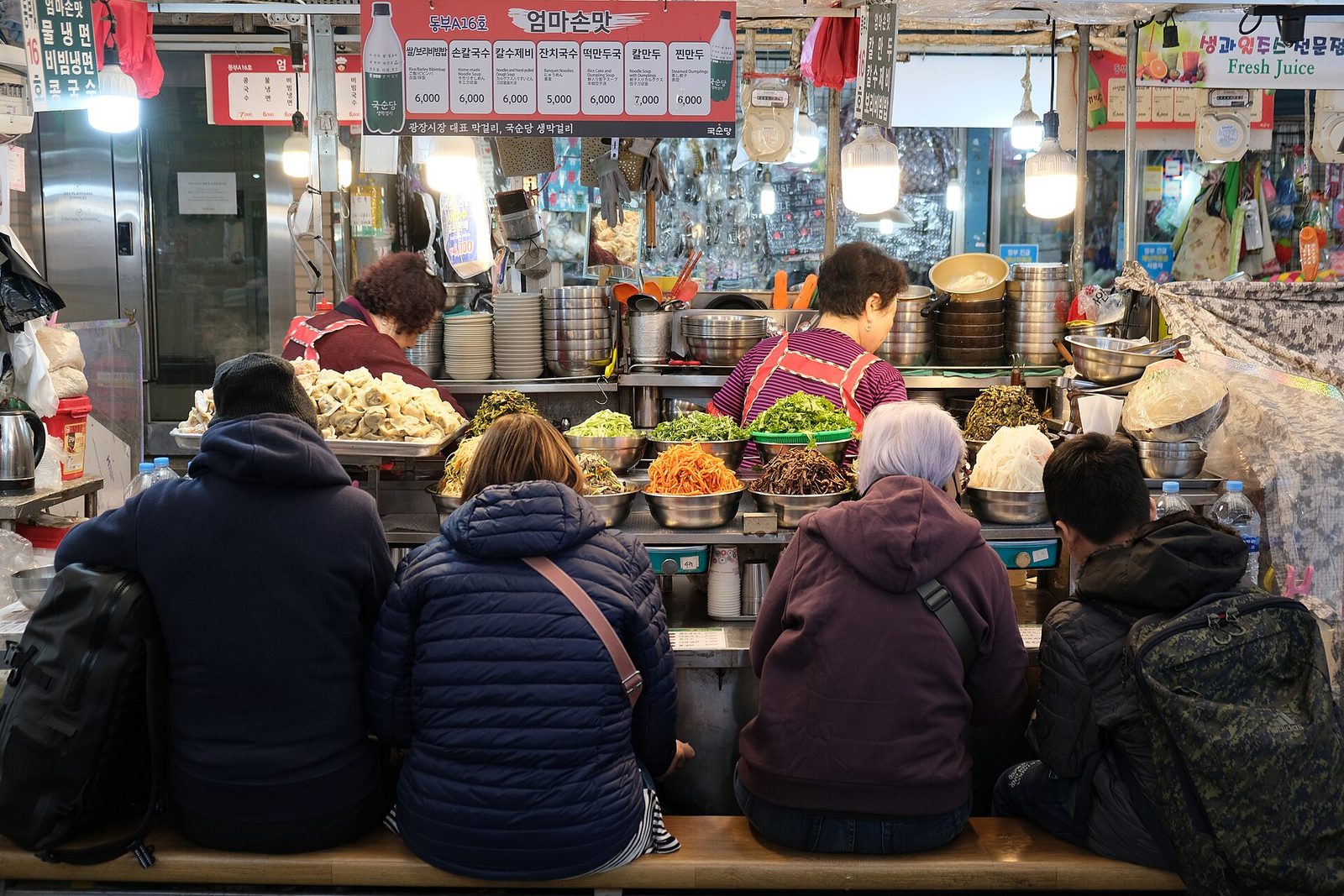
Ordering in a Korean restaurant is easy once you know the pattern, even if you don't speak Korean. The main differences from home are how you get the staff's attention, how often you order on a tablet or kiosk, and the fact that you usually pay at the counter on the way out. Here is the whole process from the door to the bill.
1. Getting a table
Staff will usually greet you with "eoseo oseyo" (welcome). Show the number in your group with your fingers. In many casual restaurants you simply sit at any free table; in busier ones, wait to be shown. Popular places may have a waiting list on a tablet by the door, or a queue outside.
2. Three ways to order
Calling the staff
Many tables have a call button. Press it and someone will come. If there isn't one, it is normal to raise your hand and call "jeogiyo" (저기요, excuse me). It isn't rude; staff won't come to the table unless called.
A tablet at the table
Many restaurants now have an ordering tablet on each table. Look for a language button in a corner of the screen, as many have English. Add dishes, then send the order. Drinks and extra portions are ordered the same way.
A kiosk at the entrance
In fast food chains, cafes and some casual restaurants you order and pay at a kiosk by the door, then wait for your number. Some kiosks don't accept foreign cards; if yours is refused, ask the staff to take payment at the counter.
3. What to know about the menu
- Portions: menus often list prices per serving (inbun, 인분). At barbecue restaurants, many places require at least two servings.
- One dish per person: some restaurants expect each person to order a main dish, so sharing one dish between two may not be allowed.
- Sizes: sharing dishes may come in small, medium and large (소, 중, 대).
- Side dishes (banchan): come free with the meal, and refills are usually free too. Some places have a self-service side dish bar.
If the menu is only in Korean, our guide to reading a Korean menu helps, and a camera translation app such as Papago or Google Lens works well.
Not sure what to order? Our list of Korean food to try in Seoul gives 20 dishes with their Hangul names and how spicy each one is.
4. Asking for changes
Requests are usually understood if you keep them short:
- Not spicy: "an maepge juseyo" (안 맵게 주세요). Some dishes are spicy by nature and can't be changed much, but some places can make them milder.
- Without meat: "gogi ppaego juseyo" (고기 빼고 주세요). Note that many broths and kimchi contain fish or seafood, so vegetarians should ask carefully. Our vegetarian, vegan and halal guide has more phrases.
- More side dishes: "i-geo deo juseyo" (이거 더 주세요, more of this please), pointing at the dish.
If you have a serious allergy, carry a card that explains it in Korean. Staff may not be able to confirm every ingredient in English.
5. Water, cutlery and napkins
Water is free, but in many restaurants it is self-service from a dispenser or a fridge. Spoons and chopsticks are often in a drawer built into the side of the table, and napkins in a box on the table or wall.
6. Paying
In most Korean restaurants you don't pay at the table. Take the bill (or just yourselves) to the counter by the door and say "gyesan halgeyo" (계산할게요, I'd like to pay). Cards are accepted almost everywhere. Splitting the bill is possible, but it is simpler to pay together and settle up later. Tipping is not expected.
Eating alone
Eating alone (honbap) is common in Korea, and many places welcome solo diners, especially those serving soups, noodles, rice bowls and set meals. Barbecue restaurants and dishes cooked for the table are harder alone because of minimum orders.
Want to learn the most useful phrases? See 10 Korean restaurant words worth knowing and our guide to Korean dining etiquette.
FAQ
Is it rude to call out "jeogiyo"?
No. It is the normal way to get a server's attention in Korea.
Do I need to tip in Korean restaurants?
No. Tipping is not part of restaurant culture in Korea.
Can I order if the restaurant has no English menu?
Yes. Pointing at pictures or at what other tables are eating works, and a camera translation app can read the menu for you.