South Korea’s currency is the won, written 원 in Korean and shown with the symbol ₩. You may also see the international code KRW on exchange screens and bank statements. A shop price such as 8,000원 means 8,000 won. Knowing the denominations and a few Korean number words makes menus, market shopping and transport easier to handle.
What does “won” mean?
Won is the name of South Korea’s currency; it is not a synonym for a particular coin or note. The Korean word is 원 (won), and the symbol ₩ usually appears before an amount in international writing, as in ₩10,000. On Korean menus and receipts, the amount often comes first, followed by 원: 10,000원.
South Korea and North Korea have separate currencies, both called won in English. In Seoul, Busan or Jeju, prices and cash are in South Korean won, or KRW. At Incheon Airport, exchange boards normally show KRW alongside currencies such as USD, JPY and EUR.
The notes you are most likely to use
South Korean banknotes come in four everyday denominations: ₩1,000, ₩5,000, ₩10,000 and ₩50,000. The different colours and portraits make them relatively easy to sort once you have handled a few. The ₩1,000 note is blue and features scholar Yi Hwang; the ₩5,000 note is reddish and shows scholar Yi I. The green ₩10,000 note features King Sejong, whose reign is associated with the creation of Hangul, the Korean alphabet. The yellow-brown ₩50,000 note features Shin Saimdang, an artist and writer.
For small purchases, a ₩1,000 or ₩5,000 note is handy. The ₩50,000 note is useful for a larger bill but can be awkward at a tiny street stall soon after you open your wallet. If you want to see official images and details of Korean currency, the Bank of Korea’s website has information about banknotes and coins.
Coins: keep an eye on the silver ones
In everyday use, you are most likely to encounter ₩10, ₩50, ₩100 and ₩500 coins. The ₩500 coin is the largest and is easy to spot; the ₩100 coin is also common. The ₩10 coin is small, so check your change before putting it away. ₩1 and ₩5 coins exist as denominations, but visitors rarely see them in ordinary transactions.
The designs offer a small glimpse of Korean history and culture. The ₩100 coin shows Admiral Yi Sun-sin, while the ₩500 coin features a flying crane. Change from a convenience store or a market stall is where most coins come from. They are handy for topping up a transport card or paying for a street snack; our street food guide covers what to buy with them.
How to read prices and say amounts
Korean prices often use commas in groups of three digits: 3,500원, 12,000원 or 50,000원. The number system can sound different from English because larger amounts are grouped by ten-thousands. For example, 10,000 is 만 (man), and 12,000 is 만 이천 원 (man i-cheon won). You do not need to master Korean counting to pay, but recognising “man” helps when someone says a price aloud.
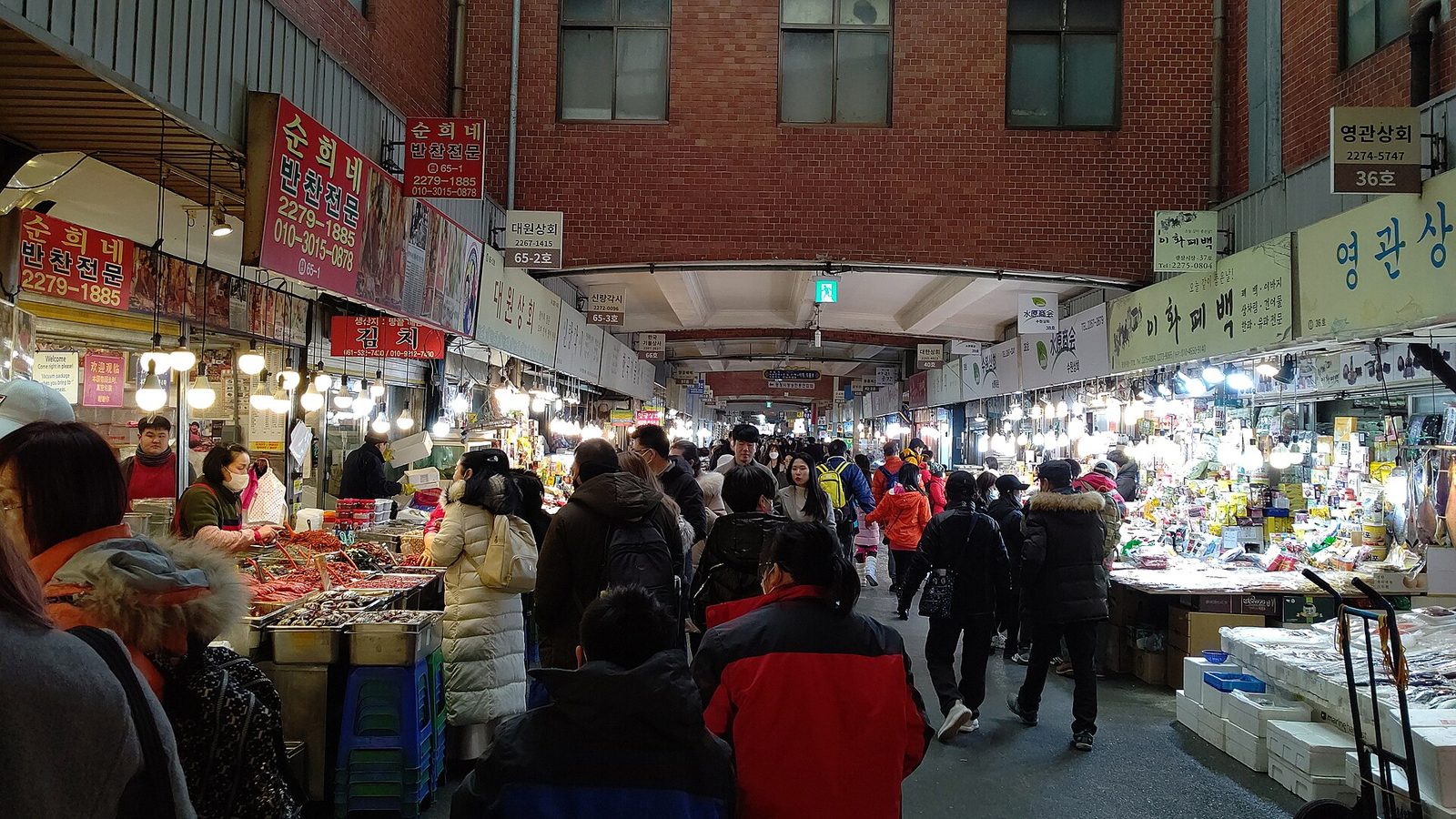
At a Seoul café, you might see 아메리카노 (americano) on the menu followed by an amount in won. In a traditional market, a vendor may show you the total on a calculator. It is perfectly normal to point to the displayed amount or enter a number on your phone if you are unsure. Before tapping your card, check that the terminal shows the amount you expect.
Cash, cards and transport cards
Cards are widely used in Korean cities, including at department stores and many restaurants. Cash is still useful for small purchases, some market stalls and occasional situations where a foreign card does not work. Our cash and cards guide explains which cards work best. At Gwangjang Market in central Seoul, for example, individual food stalls can have different payment options, so carrying a few small notes is sensible.
A transport card such as T-money is useful for Seoul subway trains and buses. You can buy or top up a T-money card at many convenience stores, including branches of CU and GS25, and at subway station machines. Top-ups are generally made in cash, so a few ₩10,000 notes are worth keeping for this. A loaded card saves you from buying a separate ticket for each metro ride; see our T-money card guide for how it works. Check the card’s current use and refund details on the official T-money website.
Getting cash and avoiding payment surprises
If you need cash, look for an ATM marked “Global ATM” or one displaying your card network’s logo. You can find ATMs at Incheon Airport, major subway stations and some convenience stores. A machine may charge a local fee, and your own bank may add another charge. If it asks whether to convert the withdrawal into your home currency, choosing KRW usually avoids the ATM’s exchange conversion; your card issuer then handles the conversion under its own terms.
Currency exchange counters are available at Incheon Airport and in central areas such as Myeongdong. Compare the displayed rates and any fees before exchanging, and keep your receipt until you have counted the cash. Our money exchange guide and ATM guide go into more detail. When planning a route to an ATM or exchange counter, Naver Map can help identify nearby locations and show walking directions.
A simple first-day plan
Keep a small note and a few coins separate from your larger bills, and carry a card as a backup. If you are using the subway from Seoul Station, buy or top up a T-money card before heading through the gates. Then look at the amount on your receipt or screen and remember the basic pattern: the currency is won, the symbol is ₩, and a Korean price ending in 원 is an amount of South Korean money.
Frequently Asked Questions
What does KRW mean, and is it different from the won?
KRW is the international currency code for the South Korean won; it does not mean a different currency. You may see prices written with the won symbol, ₩, or with KRW in travel and banking information. Both refer to South Korea’s currency.
Which banknotes and coins are commonly used in South Korea?
Common banknotes are 1,000, 5,000, 10,000, and 50,000 won. Coins you may encounter include 10, 50, 100, and 500 won. The amount is printed on each piece, so check the number when handling unfamiliar money.
Is it useful to carry coins as a visitor?
Keeping a few coins can be handy for small purchases or situations where you choose to pay in cash. You do not need to collect every denomination. Cash and card options can vary by business, so carrying some cash as a backup may be convenient.