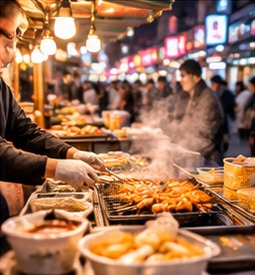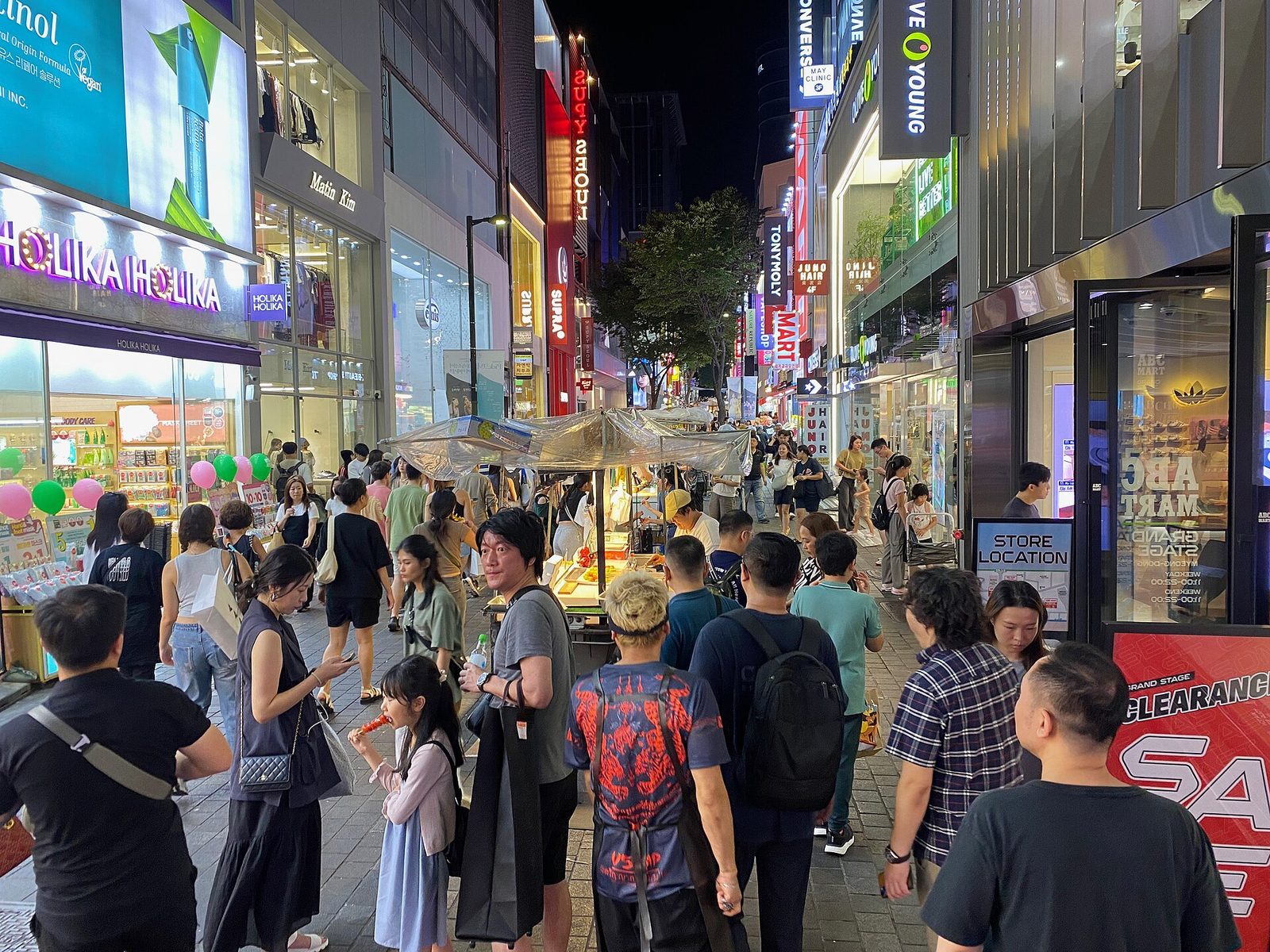
Myeongdong is one of Seoul’s easiest places to try several Korean street foods in one evening. As the shopping streets fill with people, mobile stalls set up along the pedestrian lanes and serve snacks such as tteokbokki, hotteok and grilled seafood. It is lively, central and convenient—but it is not a single, officially managed market with one entrance or fixed menu. Stall locations, choices and prices can change.
Where the night market is
Look around the main shopping streets between Myeongdong Station and Myeongdong Cathedral, including the busy lanes near the large cosmetics shops. The stalls are outdoors, so the experience depends on the weather and the season. They usually become part of the evening scene rather than operating like a daytime food hall. If you arrive and see few carts, walk the nearby shopping lanes before deciding the market is quiet.
For the simplest route, take Seoul Subway Line 4 to Myeongdong Station and head out around Exit 6 toward the shopping streets. Line 2’s Euljiro 1-ga Station is another option; from there, walk toward Myeongdong’s central shopping area. The streets are crowded at busy times, so allow extra time if you are meeting someone. Naver Map and KakaoMap are useful for walking directions; search “Myeongdong Street” or “Myeongdong Cathedral” rather than expecting a single night-market pin.
What to eat first
Start with a few familiar favourites, then choose something that looks good at the stall. Tteokbokki (떡볶이) is chewy rice cake in a spicy, sweet-red sauce. Odeng, also called eomuk (오뎅 or 어묵), is fish cake served on a skewer, often with warm broth. Hotteok (호떡) is a griddled pancake with a sweet filling, while gyeranppang (계란빵) is a small egg bread that is easy to eat while walking.
Stall menus may also include grilled cheese, prawns, scallops, potato snacks and fruit desserts. These are often aimed at visitors and can cost more than a simple Korean snack. Try one small item at a time: the portions can be filling, and you will have room to compare stalls. For a less spicy choice, point to eomuk or gyeranppang and ask, “안 매워요?” (an maewoyo?—“Is it not spicy?”). Recipes and spice levels vary, so this is a question, not a guarantee.
Prices and paying
Street-food prices vary by stall and ingredient. As a rough guide in 2026, a basic snack may cost around ₩5,000–₩10,000, while seafood or more elaborate items may be around ₩10,000–₩20,000 or more. Check the displayed price before ordering, especially for items sold by weight or by piece. If there is no clear price, ask “얼마예요?” (eolmayeyo?—“How much is it?”) before the food is prepared.
Bring a little cash, even if you normally pay by card. Payment options differ between vendors, and a small stall may not take the card you use elsewhere. A T-money card is useful for subway and bus journeys, but it is not a substitute for payment at food stalls. If you need cash, look for an ATM in a nearby bank branch or convenience store and check its foreign-card instructions before withdrawing.
How to order and eat comfortably
Many stalls have short queues, and the serving space is limited. Decide what you want before reaching the front, show the item if the menu is hard to read, and have your payment ready. You can say “이거 하나 주세요” (igeo hana juseyo—“One of this, please”). For two, say “두 개 주세요” (du gae juseyo). A translation app with its camera function can help with printed menus, but pointing and asking the price is often quicker.
Most market food is made to eat while standing or walking; do not expect tables with every stall. The lanes can be packed, so step aside before stopping to take photos or open a hot cup of broth. Use the bins provided, and keep skewers and cups until you find one. If you want a proper sit-down meal, nearby restaurants and department-store food halls are more comfortable choices than trying to balance several dishes in the crowd.
Timing, weather and what to bring
There is no single timetable for every cart. The number of stalls and the crowd can vary with the day, weather and season, so do not plan around one exact opening time. Rain or cold can make an outdoor food crawl less pleasant; wear comfortable shoes and bring a small umbrella if the forecast calls for rain. Myeongdong’s shopping streets are also busy on weekends and during holiday periods, when moving between stalls can take longer.
Keep your bag zipped and your phone secure in the crowd, and carry tissues or hand wipes. If you have a food allergy, show the ingredient name in Korean as well as saying it in English. For example, “새우” (saeu) means shrimp and “땅콩” (ttangkong) means peanut. Street stalls may share cooking surfaces or utensils, so asking about one ingredient cannot always rule out cross-contact.
Make it part of a Seoul evening
Myeongdong is easy to combine with nearby sights: visit Myeongdong Cathedral, then return to the shopping streets for a snack, or walk toward Namdaemun Market for a different market atmosphere. The official Visit Seoul website has neighborhood information, while Naver Map or KakaoMap can help with the route back to your hotel or station; check current details there if you need a specific stall or accessible route. For a first visit, keep the plan simple: arrive by subway, try two or three small dishes, and leave time to explore the lanes instead of chasing one famous cart.
Frequently Asked Questions
When is the best time to visit Myeongdong’s street-food stalls?
Myeongdong’s street-food stalls are generally associated with the evening, but activity and selection can vary by day, weather, and vendor. If you have a particular snack in mind, don’t rely on a precise schedule. Check the area when you arrive, and keep a nearby meal option in mind.
Should I bring cash for street food?
Payment methods vary from stall to stall. Carry some Korean won in cash, and ask before ordering whether a vendor accepts your card or another payment method. Don’t assume every stall takes cards, and check the amount and payment method before your food is prepared.
Can I find food that suits my dietary needs or allergies?
Options and ingredients vary, so ask the vendor about the food before ordering. If you have an allergy, explain it clearly and ask about ingredients and possible contact with other foods. A translated note can help, but if you’re unsure about an answer, choose something else.